Tire and inflation gear
Tire and inflation gear
Choose tire-pressure gear that fits your car, power source, storage space, and maintenance routine.
What to know first
A pressure gauge tells you whether the tire is at the vehicle's recommended pressure; an inflator adds air when pressure is low. Neither tool repairs tire damage or replaces the tire placard, owner manual, or professional tire advice.
- Start with a readable gauge because every pressure decision depends on measurement.
- Choose an inflator by power source, hose reach, pressure range, duty cycle, and storage size.
- Use the vehicle tire placard and owner manual for target pressure and compatibility.
Inflator vs. pressure gauge
A tire pressure gauge is the measuring tool. It helps you check cold tire pressure against the vehicle placard and notice slow pressure loss. A tire inflator is the air source. It helps add air, but it should still be paired with a gauge or a verified built-in display so you do not overinflate.
Start with measurement
For most drivers, the first tire item to keep in the car is a gauge that is easy to read and does not depend on a dead battery. Add an inflator when you want a way to top off low tires between service stops, especially before road trips or seasonal temperature swings.
- Gauge: check range, readability, valve-stem access, and storage size.
- Inflator: check power source, hose reach, duty cycle, pressure ceiling, and instructions.
- Safety limit: do not use either tool to ignore visible tire damage, rapid pressure loss, or a spare-tire procedure in the owner manual.
Tire gear at a glance
Use the tire placard and owner manual as the source for target pressure. These tools help with checking and adding air; they do not repair tire damage or make a roadside stop safe.
| Gear type | What it helps with | What to check before buying |
|---|---|---|
| Tire pressure gauge | Checking whether each tire is at the pressure listed on the vehicle placard. | Readability, pressure range, valve-stem access, battery needs, and storage size. |
| 12V tire inflator | Adding air from the vehicle's auxiliary power outlet. | Cord and hose reach, pressure ceiling, duty cycle, fuse requirements, and instructions. |
| Cordless tire inflator | Adding air without routing a power cord from the vehicle. | Battery maintenance, charger storage, runtime, pressure accuracy, and cold-weather limits. |
| Tire repair or sealant product | Temporary mobility only when the product and vehicle instructions allow it. | Tire-pressure monitoring compatibility, expiration date, speed limits, and professional repair needs. |
Recommended gear
These records are based on documented specifications and source checks. We have not performed firsthand testing unless explicitly stated.
Portable tire inflator
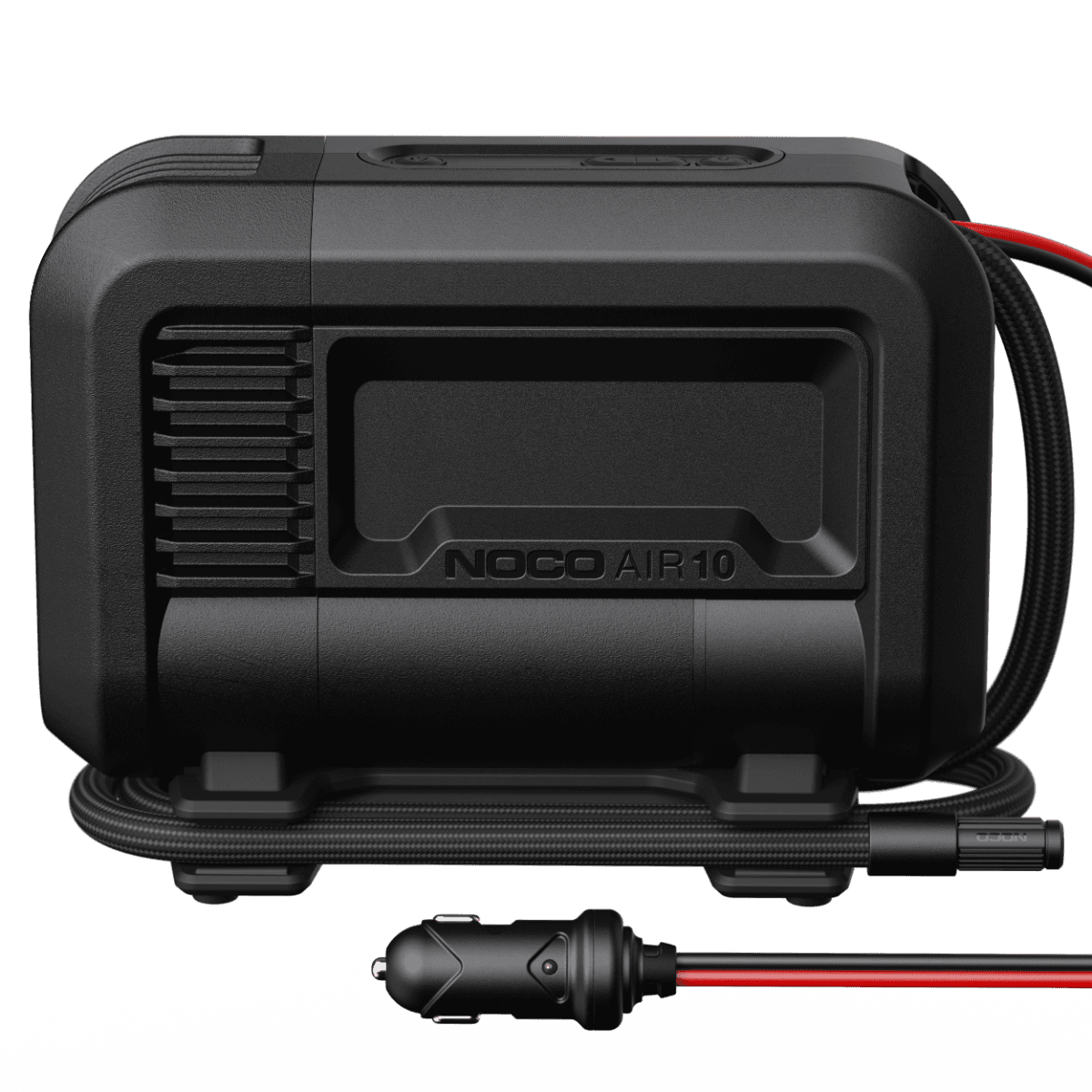
NOCO AIR10 Portable Air Compressor
Best for: Drivers who want a compact 12V inflator with auto-shutoff for cars, SUVs, motorcycles, trailers, and light-duty truck pressures up to 60 PSI.
- Verified source
- Manufacturer documentation checked 2026-10-18
- Compatibility note
- NOCO states AIR10 is for applications up to 60 PSI, including cars, SUVs, motorcycles, ATVs, UTVs, lawnmowers, trailers, and light-duty trucks.
- Power source
- 12V auxiliary power, 10A.
- Dimensions
- 8.11 x 2.93 x 6.25 inches per NOCO specifications page.
- Weight
- 5.39 lb per NOCO specifications page.
- Included accessories
- 3-foot braided inflation hose, 10-foot power cord, 12V cigarette lighter plug, Microfiber storage bag, Presta adapter, Needle adapter, Inflatable toy adapter
- Warranty note
- NOCO one-year limited warranty per official product page.
- Last checked
- 2026-10-18
Why consider it
- NOCO states auto-shutoff and dynamic dwell pressure monitoring.
- Official page states a 25-minute duty cycle at 30 PSI.
- Uses the same official manufacturer source pattern as the verified GB40 record.
Tradeoffs
- 60 PSI ceiling may not fit every high-pressure tire use case.
- Depends on a usable 12V auxiliary outlet.
- Exact fit still depends on tire requirements and product instructions.
Alternatives to compare
- VIAIR 88P
- Cordless tire inflator
Image rights: Official NOCO product page image sourced from no.co/air10 on 2026-10-18.

Tire pressure gauge
JACO ElitePro Tire Pressure Gauge 100 PSI
Best for: Drivers who want a battery-free analog gauge with documented ANSI B40.1 calibration and a flexible hose.
- Verified source
- Manufacturer documentation checked 2026-10-18
- Compatibility note
- JACO recommends it for passenger vehicles, motorcycles, bicycles with Schrader valves, trailers, RVs, motorhomes, scooters, and spare tires.
- Power source
- Battery-free analog gauge.
- Dimensions
- 2-inch glow-in-the-dark dial with 10-inch HybridFlex hose per JACO page.
- Weight
- 0.35 lb per Amazon product detail record; official JACO page does not list weight.
- Included accessories
- Analog tire pressure gauge
- Warranty note
- JACO lifetime warranty per official product page.
- Last checked
- 2026-10-18
Why consider it
- Battery-free design avoids dead batteries in a glovebox.
- Official page states ±1.5% accuracy and ANSI B40.1 calibration.
- Flexible hose and swivel chuck can make awkward valve stems easier to reach.
Tradeoffs
- 100 PSI range is unnecessary for many everyday drivers and insufficient for some specialty uses.
- Analog dial may be less compact than pencil gauges.
- Vehicle placard still supplies the target pressure.
Alternatives to compare
- Digital tire pressure gauge
- Pencil gauge
Image rights: Official JACO product page image sourced from jacosuperiorproducts.com on 2026-10-18.
Relevant gear path
Next gear choices
Use the tire placard for target pressure, then choose gear that fits your power source, storage, and routine.
How to use this guidance
Use the vehicle tire placard as the target-pressure source, then choose gear that makes checking or adding air realistic for your routine.
Checks that matter
- Confirm pressure range, display readability, and units.
- Check hose and cord reach against tire position and vehicle outlet location.
- Review duty cycle, battery maintenance, and operating limits.
Important limitation
Inflators and gauges do not repair tire damage. Visible tire damage or pressure loss needs tire-professional guidance.
FAQs
What question does Tire and inflation gear answer?
Orient readers to inflation and gauge content. A pressure gauge tells you whether the tire is at the vehicle's recommended pressure; an inflator adds air when pressure is low. Neither tool repairs tire damage or replaces the tire placard, owner manual, or professional tire advice.
What should I verify for tire gear?
Use the tire placard for target pressure, then check pressure range, power source, hose or chuck reach, operating limits, and whether the product is realistic to keep in the car.
Does this replace the vehicle manual?
No. Your vehicle manual, tire placard, and product instructions control compatibility, pressure, charging, storage, and use.
Does this gear make a roadside stop safe?
No product or checklist can guarantee safety. The goal is to help you organize practical gear and understand limitations before you buy.
Related guides in this category
Sources
- Summer Driving & Road Trip Tips, NHTSA. Checked 2026-10-18. Baseline road-trip vehicle checks and roadside-kit contents.
- Winter Weather Driving Tips, NHTSA. Checked 2026-10-18. Baseline winter vehicle-preparation and emergency-supply guidance.